
Institute of Metal Research, Chinese Academy of Sciences: Materials and Manufacturing Processes of Directionally Solidified Turbine Blades for Heavy-Duty Gas Turbines
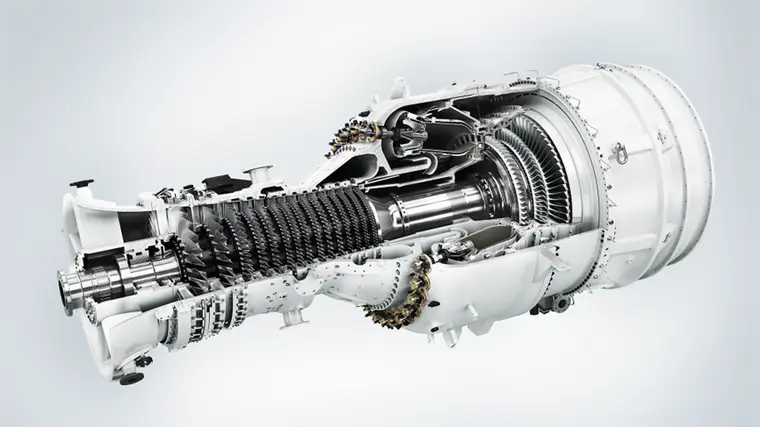
Heavy-duty gas turbines serve as core equipment in national energy development strategies. Turbine blades operating under high temperature and thermal corrosion conditions are critical hot-end components of heavy-duty gas turbines.
Compared with aero-engine blades, advanced heavy-duty gas turbine turbine blades operate long-term in harsh high-temperature thermal corrosion environments with larger structural dimensions, imposing distinctive requirements on superalloy materials and corresponding manufacturing processes.
Thermal corrosion-resistant superalloys for gas turbine blades have evolved from polycrystalline to directionally solidified and single-crystal structures. Such alloys feature high chromium content and elevated titanium-aluminum ratio, distinctly differing from materials applied to aero-engine blades.
The development of cast superalloys for gas turbines that integrate high strength, superior thermal corrosion resistance and long-term microstructural and property stability poses considerable technical challenges.
Directional solidification stands as one of the pivotal manufacturing technologies for large directionally solidified blades of heavy-duty gas turbines. This paper presents the advancement of high-temperature-gradient liquid metal cooling directional solidification technology, analyzes the effects of diverse directional solidification processes on typical microstructure and mechanical properties of superalloys, and briefly summarizes recent domestic research progress in the development of large directionally solidified blades.
Gas turbines cover aerospace jet engines, power generation and drive turbines, marine propulsion turbines and various micro gas turbines.
Currently, the combined gas-steam cycle system achieves the highest thermal-to-mechanical conversion efficiency among large-scale commercial power generation technologies available worldwide. In recent years, gas turbine combined cycle units contribute around 36% of the annual newly installed power capacity globally, with their output power and thermal efficiency steadily improving.
Coal-fired power generation remains overwhelmingly dominant in thermal power sector, while gas turbine power generation is mainly deployed for peak load regulation and accounts for a minor share of total power output. Environmentally speaking, sulfur dioxide and nitrogen oxide emissions from coal-fired power plants severely restrict the sustainable development of the power industry.
Given its vital role in advancing clean energy and promising market prospects, heavy-duty gas turbines have been incorporated into priority energy research themes in Medium and Long-Term Science and Technology Development Program, focusing on clean, efficient coal exploitation, liquefaction and poly-generation technologies. will vigorously expand the gas turbine industry, targeting an installed gas turbine power capacity of approximately 60,000 MW by 2020.
Core technologies of heavy-duty gas turbines are monopolized by a handful of enterprises, including GE of the US, Siemens of Germany and Alstom of France. After years of development, Dongfang Electric of and MHI of Japan have launched complete gas turbine product lines. Nevertheless, core technologies covering design, control, combustion and hot-end component manufacturing remain controlled by the aforesaid corporations.
Given the huge market demand and the pivotal position of gas turbines in future energy mix, the research, development and industrialization of core heavy-duty gas turbine technologies carry profound strategic significance.
Primary and secondary large guide vanes and turbine blades, the critical hot-end components of heavy-duty gas turbines, are predominantly fabricated from directionally solidified columnar-grained or single-crystal superalloys via mature directional solidification techniques. These materials and technologies share close correlation with those applied in aero-engine blades. The material and manufacturing technologies for directionally solidified blades have become a bottleneck restricting the mass development of advanced gas turbine equipment industry.
Characteristics of Heavy-Duty Gas Turbine Blades
Heavy-duty gas turbines are primarily fueled by natural gas and fuel oil. The emerging Integrated Gasification Combined Cycle (IGCC) technology also utilizes coal gasification syngas as fuel.
Operating environments and characteristics differ greatly from aero-engines, bringing distinct requirements for materials and manufacturing techniques of hot-end turbine blades. Typical properties of the two blade types are compared herein. Photos show two directionally solidified blades: the first-stage high-pressure turbine blade of GE F-class gas turbine and a standard aero-engine turbine blade.
Firstly, heavy-duty gas turbine blades are much larger and heavier. Aero-engine blades are 30–150 mm long and weigh 100–200 g, while their counterparts can reach 910 mm in length and 18 kg in weight.
Secondly, they differ in service hours and working modes. Heavy-duty gas turbine blades mostly run under steady conditions, with an overhaul cycle of 24,000–40,000 equivalent operating hours and total service life of 60,000–80,000 hours. Aero-engine blades experience short peak-temperature operation with higher instantaneous temperature, yet lower cruising temperature compared with the steady working temperature of gas turbine blades.
Thirdly, gas turbines consume various fuels containing vanadium, sulfur and other corrosive elements, whereas aero-engines use clean fuels. Accordingly, heavy-duty gas turbine blades need high-strength superalloys with excellent thermal corrosion resistance. Aero-engine superalloys feature good oxidation resistance but are prone to severe damage under thermal corrosion.
Like aero-engine blades, advanced gas turbine blades adopt complex cooling structures, directionally solidified (DS) or single-crystal (SC) superalloys, as well as thermal barrier coatings (TBC). The application status of typical heavy-duty gas turbine blades and coatings is illustrated.
Table 1 Comparison between Aero-engine Blades and Heavy-duty Gas Turbine Blades
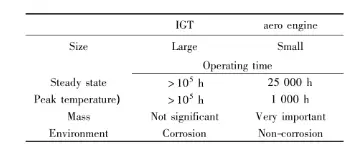
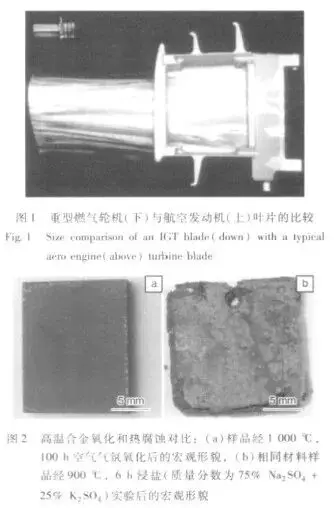
Figure 3 briefly summarizes the evolution of hot-section blade materials, cooling schemes and operating temperatures of GE gas turbines.
Before the 1970s, the rise of combustion temperature solely relied on the temperature bearing capacity of superalloy blade materials. The subsequent advancement of cooling technology continuously lifted combustion temperature, pushing material operating temperature above 850℃. It demands superior high-temperature mechanical properties and stricter thermal corrosion resistance.
Since the 1980s, directionally solidified blades with sophisticated cooling structures have been applied, greatly boosting cooling efficiency and substantially raising gas turbine combustion temperature.
Table 2 Application of Materials and Coatings for Gas Turbine Blades
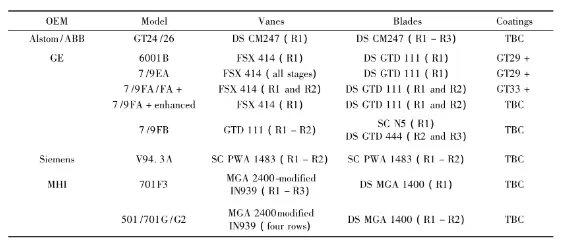
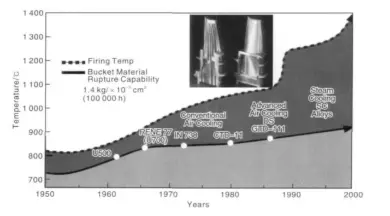
Figure 3 Evolution of Hot-section Blade Materials, Cooling Modes and Operating Temperatures of GE Gas Turbines
Superalloys Applied to Heavy-duty Gas Turbine Blades
Similar to the evolution of superalloys for aero-engine turbine blades, thermal corrosion-resistant superalloys used for overseas gas turbine blades have developed from conventional conventionally cast (CC) equiaxed grain alloys to directionally solidified columnar grain and single crystal alloys.
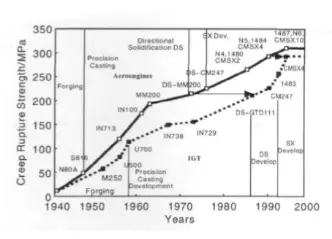
Figure 4 Evolution of Superalloys for Foreign Aero-Engines and Gas Turbines
Superalloys for gas turbine blades need balanced thermal corrosion resistance, high-temperature strength, microstructure stability and castability. Table 3 presents the main chemical compositions of typical foreign thermal corrosion-resistant superalloys. Such alloys possess the following compositional characteristics:
1,Chromium content is generally over 12 wt%. Sufficient chromium facilitates the formation of continuous protective Cr₂O₃ scale under thermal corrosion conditions. Nevertheless, chromium promotes the formation of detrimental TCP phases and delivers weaker solid-solution strengthening compared with tungsten, molybdenum and tantalum. Its content shall be strictly regulated to safeguard microstructure stability and mechanical properties.
2,Tantalum content rises progressively as alloys evolve from polycrystalline to directionally solidified and single-crystal structures. Elevated operating temperatures impose stricter requirements on high-temperature strength. Tantalum serves as a vital strengthening element. It segregates in interdendritic regions, adjusts liquid density in mushy zones during directional solidification and reduces freckle defects. It also moderately improves oxidation resistance and remarkably enhances thermal corrosion resistance.
3,Molybdenum content is kept low. Though an effective solid-solution strengthener, molybdenum triggers acidic melting reactions and severe thermal corrosion, hence its limited dosage in gas turbine superalloys.
4,Total titanium and aluminum content remains 7%–8%, with titanium content generally higher than aluminum. Both elements form γ' precipitates, and their proportional range ensures sufficient precipitate volume fraction and favorable precipitation strengthening. Titanium reacts with sulfur to form stable sulfides, restraining liquid eutectic formation and mitigating thermal corrosion. Excess titanium increases hot cracking tendency, so the Ti/Al ratio requires rational control.
5,Precious elements rhenium and ruthenium are generally absent. They greatly boost high-temperature strength and their dosage increases in advanced aero-engine single-crystal superalloys, reaching roughly 6% Re and 3% Ru in fourth-generation grades. Due to high cost and scarce reserves, commercial heavy-duty gas turbine blade materials and newly developed high-strength corrosion-resistant single-crystal alloys contain no Re or Ru. Only GE adopts second-generation single-crystal superalloy with 3% Re in newly launched G/H-class gas turbines.
6,Trace carbon, boron and hafnium are commonly incorporated. Large-sized heavy-duty gas turbine blades are prone to low-angle grain boundary defects during directional solidification. These grain boundary strengthening elements improve defect tolerance. For instance, the transverse stress rupture property of PWA1483 degrades sharply when grain boundary angle exceeds 10°, while alloys doped with trace C, B and Hf maintain stable rupture performance even at a boundary angle up to 25°.
Table 3 Main Compositions of Typical Foreign Nickel-Based Thermal Corrosion Resistant Superalloys (Mass Fraction %)
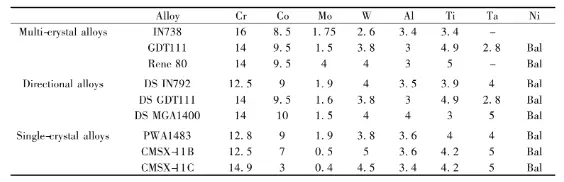
Figure 5 compares the stress rupture properties of thermal corrosion-resistant superalloys for gas turbine blades developed by the Institute of Metal Research, Chinese Academy of Sciences with typical foreign counterparts.
Starting from the early replicated equiaxed alloy K438, the strength of these alloys has been steadily improved over decades. A domestic independent intellectual property system of thermal corrosion-resistant superalloys for gas turbines has taken shape, including polycrystalline alloys K444, K452, directional solidified alloys DZ38G, DZ411, and single crystal alloys DD8, DD10.
The stress rupture performance of directional alloy DZ411 and single crystal alloy DD10 matches that of widely applied foreign counterparts DS-GDT111 and PWA1483 (Figure 6).
Salt-coated thermal corrosion test results of the two alloys are shown in Figure 7, revealing their corrosion resistance comparable to classic alloy K438. Similar results are obtained via gas thermal corrosion tests at 900℃.
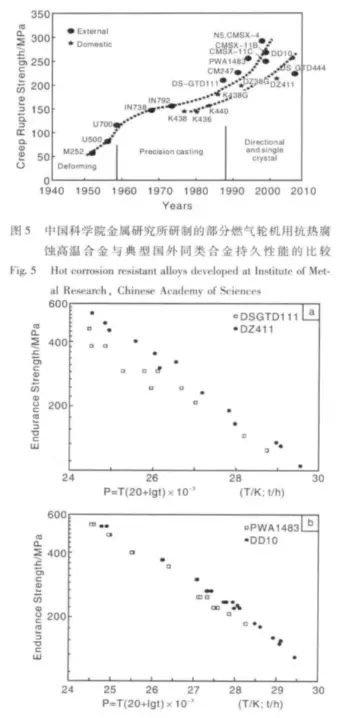
Figure 7 Thermal corrosion curves of DZ411 (a) and DD10 (b) alloys at 950℃.The salt-coating method was adopted with saturated solution consisting of 80% Na₂SO₄ and 20% K₂SO₄, and the coating dosage was approximately 2 mg/cm².
Studies on the microstructure stability of DZ411 alloy indicate no TCP phase precipitation after long-term aging at 900℃ for 24,000 hours with stable microstructure.
Figure 8 compares the microstructures of DZ411 alloy under heat-treated state, aged at 900℃ for 12,000 hours and 24,000 hours. With prolonged aging time, the cubicity of γ' phase declines and grains gradually coarsen, and massive continuous γ' phase precipitates particularly at grain boundaries.
Electron Backscatter Diffraction (EBSD) analysis shows that γ' phase grows dendritically along [011] and [111] orientations after 24,000-hour aging at 900℃, resulting in deteriorated stress rupture properties.
Desirable size and morphology of γ' phase can be restored after rejuvenation heat treatment on specimens aged for 12,000 hours, and grain boundary morphology recovers close to the original heat-treated state, as shown in Figure 9. Mechanical test results in Table 4 prove rejuvenation heat treatment an effective method to extend the service life of gas turbine blades.
DD10 single-crystal alloy boasts the highest strength among domestic thermal corrosion-resistant single-crystal superalloys. Systematic researches on solidification behavior, precipitate phases, single-crystal preparation and heat treatment regimes verify its stable microstructure and excellent castability.
Figure 10 presents γ' phase morphology of DD10 alloy under heat-treated condition and after long-term aging at 900℃. Similar to DZ411 alloy, γ' phase coalesces, grows and partially dissolves with reduced cubicity during aging. No TCP phase is detected, demonstrating favorable microstructure stability.
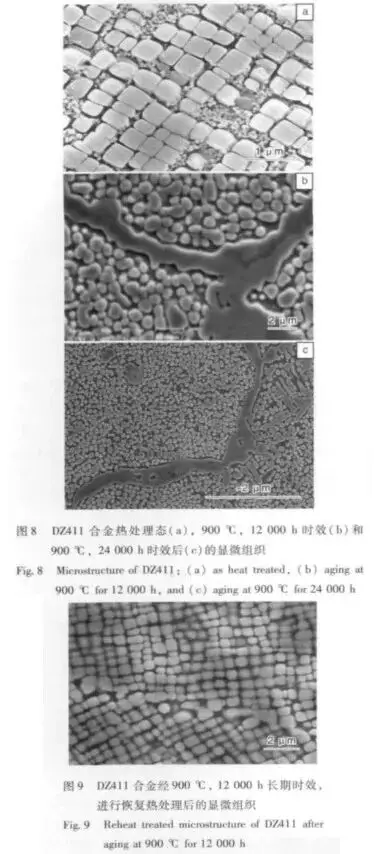
Table 4 Property Comparison of DZ411 Alloy after Aging at 900℃ for 12000 Hours and Rejuvenation Heat Treatment
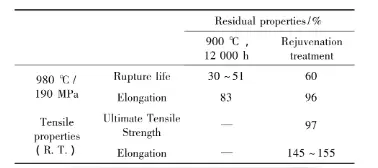
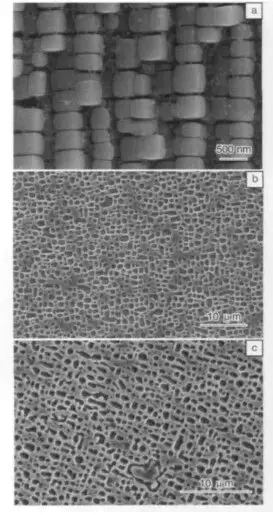
Figure 10 Microstructure of DD10 Single-crystal Alloy under Heat-treated State (a), Aging at 900℃ for 6500 h (b) and 8500 h (c)
Blade Manufacturing Technology
The manufacturing process of large directionally solidified blades for heavy-duty gas turbines covers fabrication of complex large-scale ceramic cores and shells, parameter control during directional solidification, blade heat treatment and machining, as well as preparation of long-life protective coatings. Directional solidification serves as one of the core manufacturing technologies for such blades.
High Rate Solidification (HRS) has been widely adopted to produce directionally solidified and single-crystal aero-engine blades since the 1980s. With technology transfer from aero-engine sector to gas turbine industry, HRS is also applied to manufacture large directionally solidified gas turbine blades. Given the huge dimensional disparity, key processes need re-optimization, including upgrading materials and fabrication techniques of ceramic shells and cores, optimizing wax pattern materials and design, and achieving more precise control over directional solidification parameters. Nevertheless, traditional HRS faces mounting difficulties as blade size expands.
Figure 11 illustrates the correlation between blade dimension and casting defects in directional solidification. As blade size grows, the temperature gradient ahead of solid-liquid interface declines. To stabilize the gradient and produce defect-free castings, molten superalloy must be kept at extremely high temperature with reduced withdrawal speed. Prolonged contact between reactive molten alloy and ceramic molds at 1500–1600℃ or higher triggers interfacial reactions, accompanied by creep and fracture of ceramic components. Consequently, the feasible process window for large directionally solidified blades is narrow, prone to equiaxed grain, shrinkage cavity, freckle and other defects, bringing challenges to mold making, core preparation and post-processing.
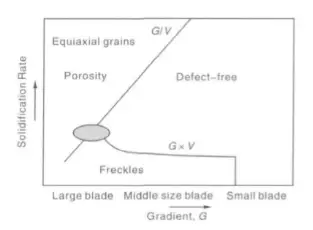
Figure 11 Schematic Diagram of Relationship between Casting Size and Solidification Defects during Directional Solidification
In the 1990s, the global heavy-duty gas turbine market expanded rapidly, driving growing demand for large directionally solidified turbine blades. To tackle the drawbacks of HRS technology in manufacturing such blades, Siemens, GE and Alstom launched engineering research on Liquid Metal Cooling (LMC) directional solidification with high temperature gradient. Around 2000, European countries completed relevant engineering research and mastered mass production technologies for large LMC blades.
Adopting low-melting-point alloy as coolant, LMC substantially elevates the temperature gradient throughout solidification, refining microstructure and raising withdrawal speed. It also brings prominent advantages for large blade fabrication. The consistently high temperature gradient allows lower molten alloy temperature and faster withdrawal rate, avoiding creep, fracture and interfacial reaction defects of large ceramic shells and cores commonly seen in HRS process. Literature [40] elaborates coolant selection, equipment and process parameter optimization, as well as microstructure and mechanical properties of LMC-produced superalloys.
In recent years, foreign scholars further optimized LMC technology combined with numerical simulation. Pollock et al. fabricated second-generation single-crystal superalloys via LMC, simulated solid-liquid interface position and primary dendrite arm spacing, and analyzed parameter effects on dendrite distribution and shrinkage cavities. Comparative tests verified that LMC effectively refines microstructure and reduces casting defects. Singer’s team found reduced cavity size and volume fraction greatly improve fatigue performance.
Domestically, Northwestern Polytechnical University conducted extensive theoretical research on alloy solidification under high temperature gradient, systematically exploring solidification characteristics and microstructure of directional and single-crystal alloys. Central Iron and Steel Research Institute developed 300 mm-long directionally solidified gas turbine blades using traditional HRS combined with numerical simulation.
The Institute of Metal Research, Chinese Academy of Sciences began exploring LMC engineering application in 2003, breaking through core technologies including thermal shock resistant shell and molten metal contamination control. A large-scale LMC equipment capable of producing 750 mm-long directionally solidified blades was developed in 2009, laying solid equipment and technical foundations. Systematic studies have been carried out on solidification process, microstructure, heat treatment, mechanical properties and castability. LMC yields remarkably refined microstructure; certain alloys can be applied directly in as-cast state without recrystallization risks from solution heat treatment, and delivers notable fatigue performance improvement for large castings hard to achieve homogenization treatment.
Domestic research on hot-section components started relatively late. The institute cooperates with domestic enterprises to develop equiaxed-grain turbine and guide blades, and conducts R&D of large directionally solidified blades. Solid directional blades of 430 mm length have been successfully manufactured. Based on breakthroughs in large thermal shock resistant shells, complex cores and directional solidification, 450 mm-long DZ411 directionally solidified turbine blades with intricate internal cooling cavities were fabricated by LMC.
Limited by low withdrawal and solidification rates, conventional HRS produces castings with primary dendrite arm spacing of 350–550 μm, prone to freckle defects induced by macrosegregation. For LMC-manufactured blades, primary and secondary dendrite spacing rise with the distance from cooling base, reaching a maximum of 320 μm at blade airfoil and tenon. Statistics of eutectic and shrinkage cavity distribution show high temperature gradient mitigates segregation, and no freckle defects are observed in finished blades.
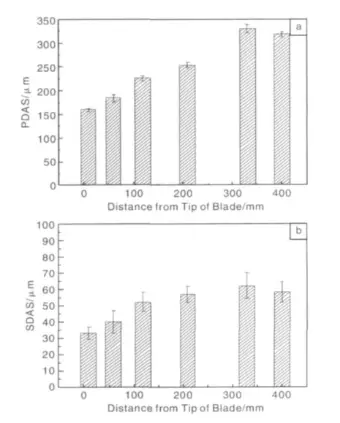
Figure 12 Statistics of Primary Dendrite Arm Spacing (a) and Secondary Dendrite Arm Spacing (b) at Different Blade Positions
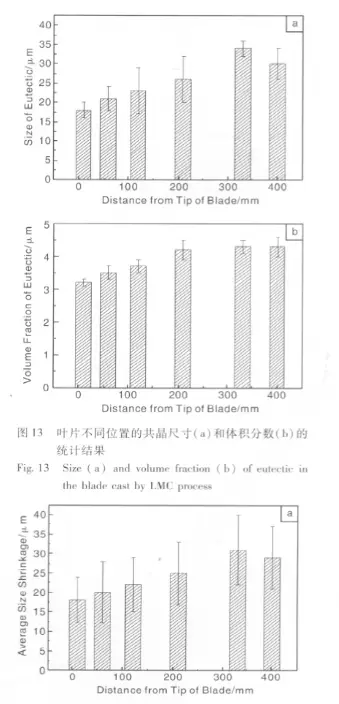
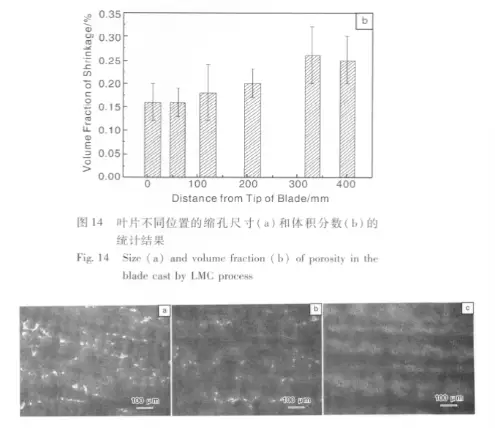
Figure 15 Typical Microstructure of DZ411 Alloy of LMC Blade after Solution Heat Treatment at 1210℃ (a), 1220℃ (b) and 1230℃ (c)
Solution temperature exerts remarkable influence on the microstructure of DZ411 alloy. Figure 15 shows typical microstructures of specimens taken from blade airfoils after solution treatment at different temperatures. The residual interdendritic eutectic decreases with rising temperature, and sufficiently high temperature can fully dissolve as-cast eutectic and realize thorough homogenization. Excessively high temperature may trigger recrystallization and incipient melting defects.
After solution and aging treatment, cubic γ' phase with size around 300 nm precipitates in the matrix, and fine secondary γ' phase forms within γ matrix channels (Figure 16).
Based on above research, the institute has developed large single-crystal blades in recent years. With numerical simulation, optimized gating system and precise solidification parameter control, 300 mm-long large single-crystal blades have been successfully fabricated (Figure 17).
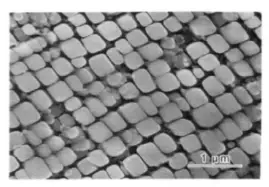
Figure 16 Typical Morphology of γ' Phase of Heat-treated DZ411 Blade
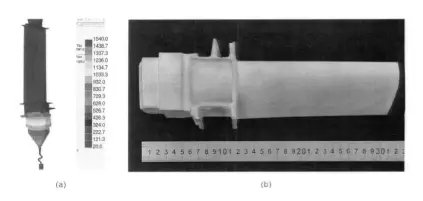
Figure 17 Temperature field distribution during directional solidification of single-crystal blade obtained by numerical simulation (a), and gas turbine single-crystal blade fabricated with DD10 alloy (b)
Conclusions
Large-sized directionally solidified and single-crystal turbine blades serve as core hot-end components of advanced heavy-duty gas turbines at present and in the future. Developing directionally solidified and single-crystal superalloys with superior comprehensive properties including mechanical performance, thermal corrosion and oxidation resistance, castability, coating applicability and long-term structural and mechanical stability, as well as mastering key manufacturing technologies for large directional solidified turbine blades, constitutes an essential guarantee for independent research and development of domestic advanced gas turbines.
It has basically established a complete system of equiaxed, directional columnar and single-crystal thermal corrosion-resistant cast superalloys. Nevertheless, intensive research is still required to realize engineering application of existing alloys and ensure independent development, efficient and reliable operation of heavy-duty gas turbines. Main research directions cover accumulation of long-term performance data of alloys and alloy-coating systems, performance verification under actual service conditions, evolution rules and damage mechanisms of microstructure and properties, as well as component life assessment and prediction. Besides, novel thermal corrosion-resistant directional and single-crystal superalloys with higher service temperature shall be developed to meet demands of next-generation gas turbines. As blade dimensions keep increasing, certain defects such as low-angle grain boundaries in single-crystal blades can hardly be eliminated completely. Hence, apart from exploring defect impacts on material properties, improving defect tolerance shall be taken into account during alloy development.
Large blade manufacturing covers directional solidification, post-treatment, machining and coating processes. Directional solidification and long-life coating technologies are the core fabrication techniques. Apart from high-temperature-gradient LMC technology, related research also involves preparation and removal of large ceramic shells, cores and wax patterns, recrystallization control during solution heat treatment and other thermal processes, as well as coating materials and preparation techniques. Further efforts are needed to achieve engineering production and application of large directional and single-crystal blades.
Service temperature of hot-end blades keeps rising. Limited improvement of temperature bearing capacity of single-crystal superalloys and high cost of precious metal elements such as rhenium make advanced cooling technologies like lamellar cooling applied in aero-engines and thermal barrier coatings vital for future development of large single-crystal blades, imposing stricter requirements on manufacturing processes.
Computational simulation acts as a crucial method to optimize fabrication processes and advance core technologies. Relevant simulation based on massive basic data supports composition design, heat treatment formulation, mechanical and corrosion behavior analysis, directional solidification optimization and defect control, as well as service performance and life evaluation. It enriches material theories and guides the research and application of advanced materials and complex hot-end components.
This article is excerpted from Materials of China.


